Regain Your Confidence: How Modern Permanent Teeth Replacements Can Help You Eat, Laugh, and Smile Naturally Again

Permanent tooth replacement options restore full oral function, natural aesthetics, and jawbone density after tooth loss. Modern restorative dentistry uses advanced titanium anchors and digital mapping to rebuild complete smiles without altering adjacent healthy enamel, restoring chewing strength, clear speech, and long-lasting confidence for adult patients.

Missing teeth often create significant daily challenges for adults across Woodbridge, impacting dietary choices and personal self-assurance. Dr. Raymond Niles, Jr. and Dr. Kathryn Niles-Smith offer comprehensive restorative care that combines decades of clinical experience with modern precision technology. Modern care centers on osseointegrated tooth replacement, a natural biological process where titanium fixtures fuse directly with native jawbone tissue to create a permanent root foundation. Patients benefit directly from cad/cam digital impressions, precise optical scans that eliminate messy impression trays while capturing intricate intraoral measurements. Through same-day CEREC restorations, custom ceramic crowns can be designed, fabricated, and anchored in a single visit, avoiding temporary prostheses completely.

Biological Necessity of Jawbone Preservation and Restorative Stability

Tooth loss triggers immediate biological changes in the underlying alveolar bone. Without functional stimulus from natural tooth roots, local bone tissue resorbs, causing structural changes in facial architecture over time. Placing a biocompatible titanium post reestablishes beneficial mechanical load, stimulating healthy bone tissue and preventing facial collapse. Surrounding natural teeth remain completely protected because titanium implants do not rely on adjacent structures for support. Furthermore, restoring full arch integrity prevents remaining teeth from drifting out of proper alignment, preserving bite equilibrium and protecting the temporomandibular joint from excessive strain.

Comparing Restorative Solutions: Traditional Bridges vs. Modern Permanent Implants

Restorative Metric Traditional Dental Bridges Modern Permanent Dental Implants Niles Dental
Structural Support Requires shaving down neighboring healthy teeth Self-supporting titanium posts anchored in jawbone
Jawbone Health Does not stop bone loss under missing tooth gap Stimulates osseointegration; tooth replacement preserves bone
Digital Fabrication Traditional impressions and external laboratory delays cad/cam digital impressions with immediate digital accuracy
Treatment Speed Multiple visits spread over several weeks Potential same-day CEREC restorations for qualified cases

Key Clinical Takeaways for Tooth Replacement Candidates

  • Restoring missing teeth protects structural jawbone density through osseointegration.
  • Advanced cad/cam digital impressions provide exact intraoral mapping without uncomfortable impression putty.
  • Same-day technology allows rapid placement of same-day CEREC restorations for seamless aesthetic results.
  • Individual implants protect surrounding enamel by eliminating the need to prepare healthy adjacent teeth.
  • Permanent replacements restore full biting force, allowing patients to enjoy diverse, nutritious diets with total ease.

Common Questions About Dental Implants in Woodbridge

Navigating tooth replacement options often brings up important questions regarding comfort, durability, and treatment timelines. Patients often want clarity on how modern technology streamlines recovery and supports long-term success. Understanding these details helps individuals feel confident and prepared as they take the next steps toward restoring their smile.

How Long Do Permanent Dental Implants Last?

Permanent implants can last a lifetime with proper oral hygiene and routine professional cleanings. Local patients appreciate that durable materials resist decay and withstand daily chewing forces effortlessly. Consistent home care, combined with regular checkups, supports long-lasting stability and oral health.

Is the Dental Implant Procedure Painful or Uncomfortable?

Local anesthesia and modern digital planning help ensure patient comfort throughout the procedure. Caring dental teams provide detailed post-treatment instructions to keep post-operative recovery smooth and manageable. Most individuals experience minimal disruption to their daily routines and recover within a few days.

Can I Replace Multiple Missing Teeth With Implants?

Modern restorative techniques allow single teeth, multiple missing teeth, or complete dental arches to be fully restored. Experienced clinicians design custom treatment plans tailored specifically to your unique anatomical needs. Comprehensive care restores full biting capability and natural smile aesthetics regardless of missing tooth count.

Schedule Your Dental Implants Consultation in Woodbridge

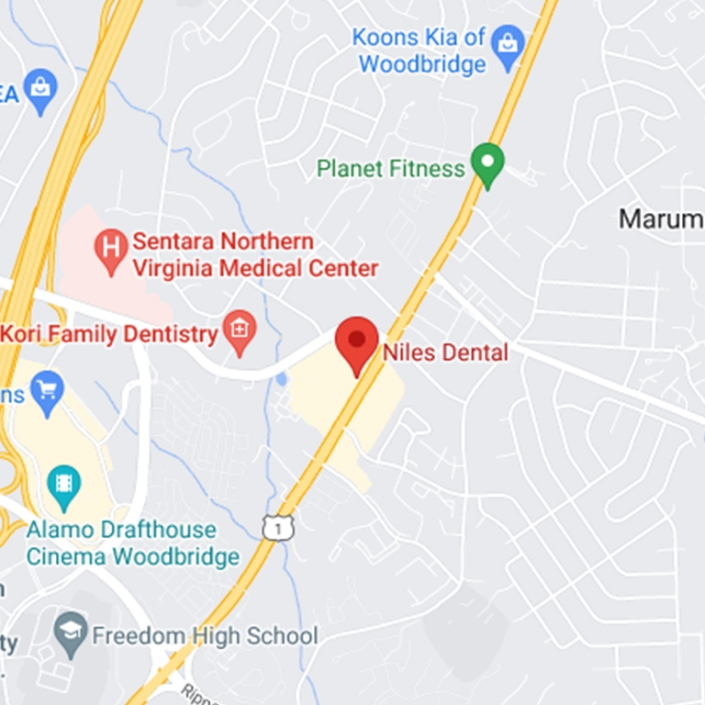
Taking the first step toward restoring your complete smile is straightforward and empowering. Niles Dental welcomes patients near Potomac Mills Mall, Stonebridge at Potomac Town Center, and across Prince William County. Contact our dedicated team today to discuss your permanent tooth replacement goals and schedule a comprehensive consultation.

Pediatric Dentistry in Woodbridge, VA

Establishing early oral hygiene routines prevents childhood dental caries and supports proper jaw development. Clinical interventions such as protective sealants and remineralizing agents safeguard primary teeth. Niles Dental delivers gentle, child-focused dental care in Woodbridge, combining advanced preventive therapies with a warm, supportive environment for growing families.

Are you searching for a welcoming clinical home where your child feels completely comfortable during routine dental visits? Parents navigating family routines near Stonebridge at Potomac Town Center require gentle, precise oral healthcare tailored for growing smiles. Dr. Kathryn Niles-Smith, DMD, provides supportive pediatric care that builds confidence while safeguarding primary teeth. Our practice utilizes a topical fluoride varnish matrix, a concentrated mineral solution painted directly onto teeth to rebuild weakened enamel and prevent decay. By establishing early positive experiences, young patients develop lifelong healthy habits without fear.

Pediatric Restorative Interventions and Preventative Enamel Defense

Primary teeth serve as crucial spatial placeholders for permanent teeth, guiding proper jaw growth and structural alignment. When deep decay threatens a primary tooth, a primary molar pulpotomy, a clinical procedure that removes infected nerve tissue from the crown portion while preserving root viability, becomes necessary to prevent early tooth loss. Maintaining these structural foundations prevents orthodontic complications later in life. Furthermore, advanced diagnostic technology allows early detection of demineralization long before visible cavities form.

Pediatric Preventive Options Comparison

Treatment Option Primary Clinical Purpose Application Time Durability / Longevity
Topical Fluoride Varnish Remineralizes early enamel decay 2 to 3 minutes Reapplied every 6 months
Dental Sealants Seals deep anatomical grooves 5 minutes per tooth 3 to 5 years
Primary Molar Pulpotomy Treats deep pulpal infections 30 to 45 minutes Lasts until natural tooth exfoliation

Key Benefits of Early Pediatric Dental Care

  • Prevents premature loss of primary teeth to maintain correct arch space.
  • Instills positive oral hygiene habits in children from an early age.
  • Utilizes painless, non-invasive fluoride applications to strengthen enamel.
  • Reduces anxiety through gentle, reassuring pediatric care protocols.

Common Questions About Pediatric Dentistry

Families across Woodbridge often wonder when to begin formal dental care for their young children. Early visits establish a foundation of trust while allowing our clinical team to closely monitor development. Navigating primary tooth care raises common questions among local parents seeking the best long-term outcomes.

When should my child have their first dental visit?

Children should visit the dentist by their first birthday or within 6 months of their first tooth emerging. Our gentle team creates a fun, stress-free environment so your little one feels entirely comfortable in the chair. Early evaluations ensure proper oral development while helping your child build positive lifelong habits.

How does fluoride varnish protect young primary teeth?

Fluoride varnish applied to teeth releases essential minerals that help rebuild weakened enamel and resist acid erosion. Parents in Woodbridge love how quick and painless this protective application is for active children. Regular applications significantly reduce the risk of childhood decay while reinforcing natural tooth enamel.

What happens if a primary tooth develops a deep cavity?

A pulpotomy removes infected crown tissue while leaving the healthy root structure intact to save the tooth. Dr. Kathryn Niles-Smith ensures every young patient remains calm and pain-free throughout the entire restorative process. Preserving primary molars prevents costly spatial shifts in developing jaws.

Schedule Your Pediatric Dentistry Consultation in Woodbridge

Conveniently located for commuters to Prince William Parkway and Route 1, Niles Dental offers flexible family appointment scheduling. Contact Dr. Kathryn Niles-Smith today to establish your child’s personalized preventive plan.

Dental Implants in Woodbridge, VA

Missing teeth compromise structural jaw integrity, clear speech, and proper mastication over time. Advanced implant dentistry restores oral health by replacing lost root structures with biocompatible posts. Niles Dental integrates digital imaging and precision placement in Woodbridge, delivering secure, natural-looking tooth replacements engineered for lifetime durability.

Restoring lost teeth requires a balance of biological science and refined artistic craft. Patients traveling along the Interstate 95 corridor near Leesylvania State Park often seek permanent solutions that restore full oral strength without altering healthy adjacent teeth. Dr. Raymond Niles, Jr., DDS delivers durable replacements using biocompatible zirconia restorations and metal-free ceramic caps designed to mimic natural enamel’s translucency and strength. This approach restores natural smiling confidence while supporting long-term structural tissue health.

Biomechanics of Osseointegration and Structural Stability

Successful tooth replacement relies on osseointegration of post-systems and medical-grade titanium or ceramic implants, which fuse directly with the jawbone tissue over several months. This biological fusion provides a stable root foundation, preventing bone resorption that typically follows tooth loss. Precise calibration of abutment torque dynamics, the specific mechanical tightness applied when securing the connecting post to the implant, prevents micro-movement and ensures long-term restoration stability under heavy chewing forces.

Restorative Options Structural Comparison

Feature Biocompatible Dental Implants Traditional Dental Bridges Removable Partial Dentures
Jawbone Retention Stimulates bone retention No impact on bone retention May accelerate bone loss
Adjacent Teeth Impact Leaves healthy teeth untouched Requires grinding neighbor teeth Uses metal clasps on neighbor teeth
Expected Lifespan Lifetime stability 7 to 10 years 5 to 7 years

Key Benefits of Biocompatible Dental Implants

  • Preserves natural jawbone density and facial skeletal structure.
  • Functions like natural tooth roots for stable chewing power.
  • Prevents unwanted shifting of neighboring teeth into empty spaces.
  • Eliminates messy adhesives and slipping associated with traditional plates.

Common Questions About Dental Implants

Deciding to replace missing teeth involves understanding treatment timelines, biological healing, and functional outcomes. Our Woodbridge clinical team guides patients through each phase of restorative care with complete clarity. Here are the top questions prospective implant patients ask during initial consultations.

How long does the dental implant integration process take?

Osseointegration typically requires three to six months for complete bone fusion around the post. Rest assured, patients, that our comfortable Woodbridge office provides temporary restorations to maintain appearance during healing. Full biological integration creates a permanent, solid anchor for your custom tooth.

Why are biocompatible zirconia restorations preferred for tooth replacement?

Zirconia offers exceptional mechanical durability and tissue-friendly properties that help prevent gum irritation. Our experienced doctors carefully match the shade and contour to ensure your new tooth looks entirely natural. Choosing biocompatible materials safeguards overall systemic health while restoring functional bite strength.

Will the implant placement procedure require significant downtime?

Most patients experience minimal discomfort and return to work within one or two days after the procedure. Dr. Raymond Niles, Jr. utilizes precise digital guides to ensure swift placement and rapid tissue healing. Careful post-treatment care instructions help you maintain complete comfort throughout recovery.

Schedule Your Dental Implants Consultation in Woodbridge

Conveniently located near Route 1 and the VRE Woodbridge Station, Niles Dental provides comprehensive implant consultations. Schedule your appointment with Dr. Raymond Niles, Jr. today to renew your smile.

Dentures In Woodbridge

Replacing a complete arch of missing teeth requires specialized structural solutions that support your natural facial features. Advanced dentures Woodbridge, VA offer modern, comfortable alternatives to traditional fabrications. These customized appliances restore your ability to chew confidently while preventing the premature aging associated with extensive tooth loss.

Are you struggling with loose teeth or missing multiple dental units along your upper or lower jaw? Many patients notice that conventional tooth replacements slip out of place during speech or meals, causing physical irritation and social anxiety. Our dental team addresses this issue by designing thermoplastic base prosthetics, which are highly flexible, lightweight oral appliances engineered to conform perfectly to the unique contours of your mouth.

Many individuals discover that updating an old, rigid dental plate instantly restores their natural speech patterns and confidence during family gatherings. Modern dental engineering allows patients to enjoy a varied diet without experiencing painful friction along the gums.

Restoring Global Facial Architecture with Advanced Neuromuscular Full-Arch Prosthetics

Long-term tooth loss invariably leads to alveolar bone resorption, a biological process where the jawbone tissue gradually shrinks due to a lack of physical stimulation. This loss of bone density causes the lower face to collapse inward, creating deep wrinkles around the mouth and a prematurely aged appearance. To combat this skeletal change, our practice focuses on achieving tissue-borne macro-stability, which means engineering a comprehensive denture foundation that utilizes the natural muscle forces of your mouth to remain firmly seated. By calculating your precise neuromuscular alignment, we can craft full-arch replacements that support your cheeks and lips, effectively restoring your global facial architecture.

Structural Advantages of Modern Removable Prosthetics

Selecting the right full-arch solution significantly impacts your daily comfort and long-term skeletal health. This comparative matrix outlines how advanced materials outperform legacy designs.

Structural Feature Traditional Acrylic Fabrications Advanced Thermoplastic Bases
Material Base Composition Thick and rigid pink acrylic plastic Flexible, lightweight nylon components
Oral Tissue Adaptation Relies on thick suction or adhesive pastes Snaps naturally over the ridge contours
Chewing Pressure Management Creates localized sore spots under heavy load Distributes forces evenly across bone tissue
Facial Profile Preservation Provides basic surface lip support only Rebuilds accurate vertical neuromuscular height

Key Milestones in Achieving Macro-Stability

Crafting a high-performance oral appliance involves precise engineering stages to ensure a flawless fit. Our clinical workflow prioritizes your unique anatomy throughout the entire fabrication process.

  • Digital Topographical Mapping: Advanced intraoral scanners capture the exact multi-dimensional shape of your dental ridges without messy impression putties.
  • Neuromuscular Alignment Verification: Specialized measurements determine the ideal structural height required to relax your jaw muscles and restore natural facial proportions.
  • Biocompatible Material Selection: Using premium medical-grade polymers ensures your appliance remains stain-resistant while maintaining optimal flexibility.
  • Comprehensive Bite Balancing: Careful adjustments eliminate high spots, ensuring your upper and lower arches meet uniformly during mastication.

Common Questions About Dentures

How long does it take to get used to speaking and eating with a new prosthetic?

Most individuals require approximately two to four weeks to adjust completely to their new dental appliance. Reading aloud at home and starting with softer foods will help your tongue adapt quickly, and our team will perform gentle adjustments to ensure your total comfort.

Will my full-arch appliance require messy adhesive creams to stay in place? Modern designs rely on precise anatomical contours to achieve reliable suction and stability without the need for regular chemical pastes. If you ever notice minor movement as your mouth naturally changes over time, we can easily reline the base to restore a snug fit.

Can a flexible base appliance be repaired if it is accidentally dropped onto a hard surface? Advanced thermoplastic materials are exceptionally durable and highly resistant to fracturing compared to old-fashioned acrylics. Should any damage occur, please bring the appliance directly to our office so our laboratory technicians can safely evaluate and correct the structure.

Schedule Your Dentures Consultation in Woodbridge

Rebuilding your smile and stabilizing your facial contours begins with an individual consultation at our comfortable family practice. Our dedicated doctors combine decades of community experience with modern restorative materials to deliver lifelike, functional results. Contact Niles Dental today to discover how custom dentures in Woodbridge, VA can revitalize your lifestyle.

Dental Implants In Woodbridge

Replacing missing teeth requires deep structural stabilization beneath the gumline to halt progressive bone loss. Advanced dental implants in Woodbridge, VA, provide modern biocompatible solutions that permanently replicate natural tooth roots. This precision clinical approach secures long-term oral health, restores full chewing mechanics, and perfectly preserves native facial architecture.

Losing a tooth alters more than just the visible surface of your smile. Deep within the jaw, the structural support system begins to decline immediately after an extraction. Patients often notice that nearby teeth begin to shift into the empty space, changing how their bite functions during daily meals. Our clinical team focuses on stopping this destructive cycle by utilizing modern technology to replicate natural oral biology.

When a natural root is lost, the underlying bone lacks the vital physical stimulation required to maintain its thickness and density. Choosing a modern structural replacement ensures that your smile remains healthy, strong, and perfectly aligned for decades to come.

Preventing Alveolar Bone Resorption and Localized Extraction Gaps

Maintaining oral health after tooth loss requires understanding a process known as alveolar bone resorption, which involves the gradual shrinking of the jawbone. When localized extraction gaps, or the empty spaces left by missing teeth, remain untreated, the bone matrix naturally breaks down. Modern dentistry addresses this biological challenge through microcellular osseointegration, a highly sophisticated process in which living bone cells fuse directly to the microscopic threads of a titanium implant post. This biological bond creates a permanent, stable anchor that functions exactly like a healthy tooth root.

Northern Virginia professionals who commute daily along Route One or the Interstate 95 corridor need efficient, long-lasting clinical results that eliminate the need for frequent dental repairs. Using digital diagnostic imaging, our team maps your exact bone depth to place each restoration with absolute precision.

Structural Comparisons for Tooth Replacement Options

Understanding your clinical choices helps you make an informed decision for your long-term wellness. This table outlines the distinct biological differences between traditional options and advanced implant technology.

Restoration Characteristic Traditional Dental Bridges Advanced Dental Implants
Bone Health Impact Allows gradual bone loss under the missing tooth area Actively stimulates the jawbone to stop tissue shrinkage
Neighboring Tooth Structure Requires drilling down and altering adjacent healthy teeth Leaves surrounding natural teeth completely untouched
Long-Term Structural Stability Relies on surface cement that may weaken over time Achieves permanent cellular integration within the jaw
Average Lifespan Expectancy Typically requires replacement after ten to fifteen years Designed to last a lifetime with proper home care

Key Biological Benefits of Precision Root Replication

Stabilizing your smile involves several distinct phases of tissue healing and structural protection. Modern restorations safeguard your oral health through specific biological mechanisms.

  • Halting Bone Degradation: The titanium post provides continuous physical stimulation to the jaw, which effectively stops the natural degradation of surrounding bone tissue.
  • Preserving Natural Alignment: Filling the empty gap prevents adjacent teeth from drifting out of place, maintaining your ideal bite balance.
  • Restoring Maximum Chewing Force: Secure structural anchoring allows you to eat standard foods comfortably without worrying about restoration movement.
  • Protecting Facial Architecture: Maintaining healthy jawbone volume prevents the sunken facial appearance often associated with long-term tooth loss.

Common Questions About Dental Implants

How long does the recovery process take after receiving an implant? Initial healing typically occurs within a few days, while the deeper bone integration process takes several months to complete fully. We understand that taking time away from a busy work schedule is difficult, so our team monitors your healing closely to ensure a smooth, comfortable journey.

Will the surgical placement process cause significant discomfort?

Local anesthetics completely numb the treatment area, meaning you will feel mild pressure rather than sharp pain during the clinical procedure. Patients routinely tell us that recovery feels highly manageable and resembles a simple extraction-healing process.

Am I a good candidate for this restorative treatment if I lost a tooth years ago? Many individuals with historical tooth loss still qualify for modern restorations, though some may require minor bone enhancement before placement. Our diagnostic imaging tools will evaluate your current jaw density to create a personalized, safe path forward.

Schedule Your Dental Implants Consultation in Woodbridge

Reclaiming a stable, healthy smile begins with a comprehensive clinical evaluation at our modern practice. Our doctors combine thirty years of community trust with advanced digital technology to deliver exceptional, compassionate care. Contact Niles Dental today to explore how dental implants in Woodbridge, VA can protect your long-term oral health.

Structural Resilience In Virginia Beach

Maintaining the internal stability of a tooth is essential for preventing sudden breakage or underlying infections. Early detection of minor flaws allows for conservative treatments that save the natural tooth. Dr. Michael Niles focuses on reinforcing weakened structures to ensure every patient enjoys a functional and pain-free bite.

Dental health often relies on identifying issues that are invisible to the naked eye. We use high-definition intraoral cameras to detect microfractures that could lead to systemic failure. These tiny cracks act as pathways for bacteria to enter the pulpal chamber, causing significant discomfort. Addressing these vulnerabilities early preserves the structural integrity of the tooth. Protective treatments help distribute biting forces more evenly across the occlusal surface.

Finding a small crack today prevents a painful emergency tomorrow. Patients are often surprised by how much a simple reinforcement can improve their overall chewing comfort.

The Science of Marginal Integrity

Long-term dental success is heavily dependent on marginal integrity, which is the seal between a restoration and the natural tooth. If this seal is compromised, decay can form underneath a crown or filling without being noticed. We use precision scanning to ensure that every restorative interface is airtight and flush with the tooth surface. This level of accuracy prevents micro-leakage and protects the sensitive inner layers of the dentin. Specialized bonding agents are applied to create a chemical and mechanical lock that withstands years of use.

Common Questions About Structural Dental Integrity

Can a tooth with a small crack really be saved? Yes, catching a fracture early allows us to use conservative bonding or a crown to hold the tooth together. We always prioritize saving your natural tooth whenever it is clinically possible.

Why does my tooth hurt when I bite down? Sharp pain during chewing is a classic sign of a structural crack. This discomfort occurs because the tooth’s components shift slightly, irritating the internal nerves.

Do I need a crown for every crack? Some superficial lines only require monitoring or simple resin fillers. We will perform a thorough evaluation to determine which treatment provides the best long-term outcome for your specific case.

Schedule Your Structural Consultation in Virginia Beach

Protect your dental health by addressing minor concerns before they become major problems. Call Niles Dental today to discuss our advanced restorative options and structural assessments.

Same-Day Restorations

Modern life in Northern Virginia moves fast, and your dental care should keep pace with your schedule. Niles Dental provides high-quality ceramic crowns in a single visit using on-site milling technology. We eliminate the need for temporary caps and multiple appointments at our convenient Daniel Stuart Square location.

Traffic on the I-95 corridor is stressful enough without adding extra trips to the dentist. Efficiency defines our approach to restorative care for commuters and busy families alike. Dr. Niles uses CAD/CAM technology, which stands for computer-aided design and manufacturing, to create your new tooth while you wait. I love being able to show patients their crown being made right in our office, he says. We start by taking an iTero Digital Scan to create a perfect three-dimensional model of your mouth. This replaces the messy, uncomfortable putty impressions used in traditional dentistry.

A local commuter recently noted that they had their permanent crown placed during a long lunch break, avoiding a second trip entirely.

Digital Precision and Milling

The process relies on Hydro-Abrasive Kinetics to refine the ceramic material into a durable restoration. Technical precision is required to ensure that the new crown fits perfectly with your existing bite. Our in-house milling unit carves the tooth from a solid block of high-grade porcelain, ensuring strength and a natural appearance. Digital workflows allow us to match the color and translucency of your neighboring teeth with incredible accuracy. This collaboration between digital imaging and mechanical artistry results in a restoration that can last for decades.

Common Questions About Same-Day Crowns

  • Are these crowns as strong as the ones made in a lab? Yes, the ceramic materials we use are identical to, or better than, those used in traditional labs. They are designed to withstand the daily pressures of chewing and are bonded permanently for maximum stability.
  • Do I have to wear a temporary crown? The biggest benefit of our technology is eliminating the temporary phase. You arrive with a damaged tooth and leave with a permanent, beautiful crown in just one visit.

Schedule Your Same-Day Restoration Consultation in Woodbridge

Save time without sacrificing quality by visiting Dr. Niles and his team. Book your digital scan today and experience the convenience of modern dentistry.